Forced Alignment Benchmark: Word-Level Timestamps on Short Utterances, Long Audio and Chinese
Forced alignment matches an existing transcript to a recording and gives every word a start and end time, with no need to transcribe again. Common uses:
- Turn a script or a proofread transcript into SRT / VTT / ASS subtitles
- Align lyrics to singing for word-highlight karaoke subtitles
- Highlight audiobooks, courses and language-learning material word by word, and jump to a word on click
- Find and cut audio or video by its text
- Add word-level timestamps to training data for speech recognition, speech generation and full-duplex models
Most alignment benchmarks only test English utterances a few seconds long, while real subtitles and audiobooks often run for tens of minutes and mix languages. Using hand labels from TIMIT and the Biaobei Mandarin corpus, we tested English short utterances, 10- to 60-minute long audio, Chinese, and English-Chinese switching, comparing EdgeSpeak, Montreal Forced Aligner (MFA), ElevenLabs Forced Alignment and Qwen3-ForcedAligner.
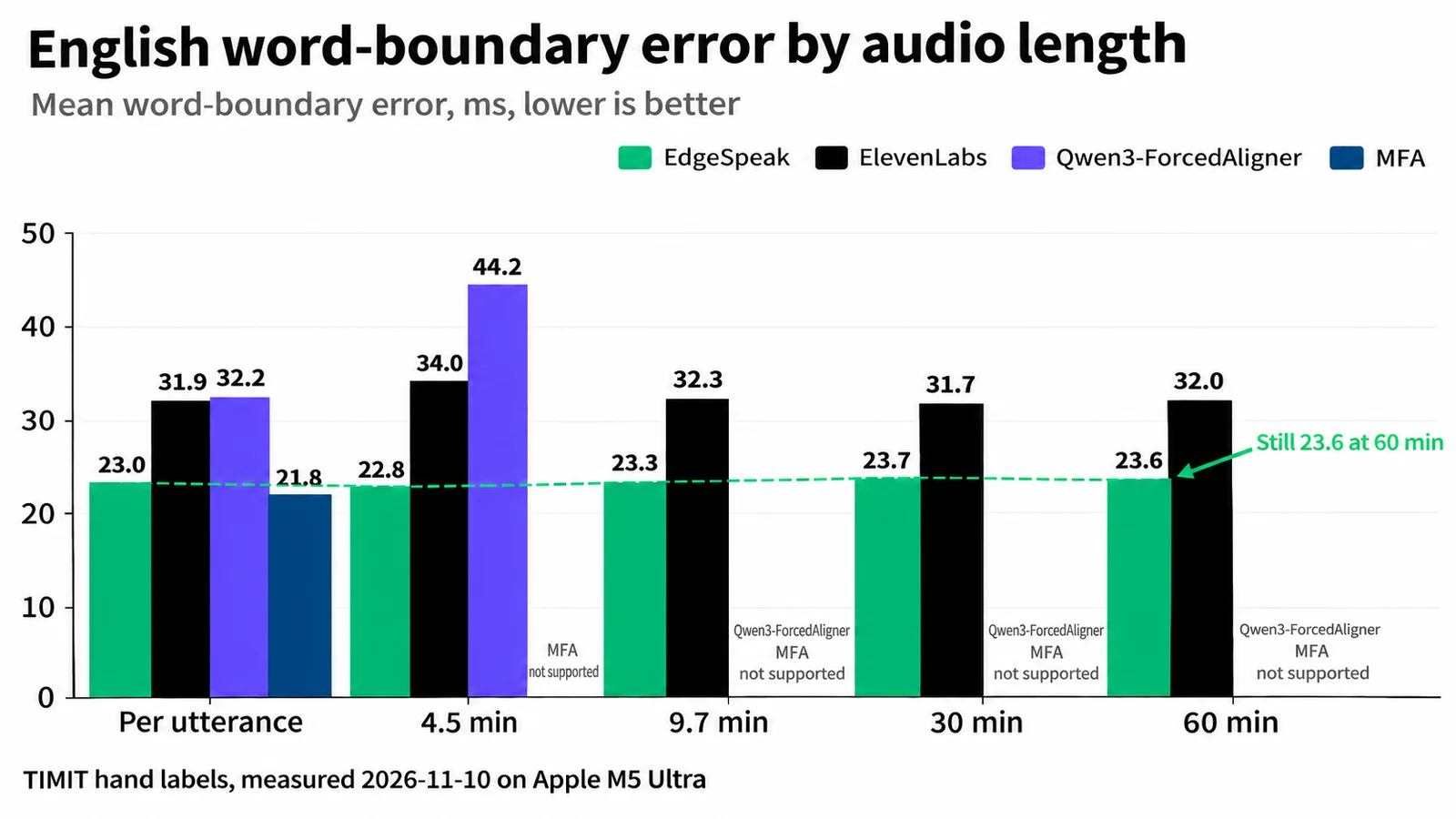
On English short utterances, EdgeSpeak's error is 23.0 ms. With the utterances joined into 60 minutes and aligned in one pass, EdgeSpeak's error is 23.6 ms and ElevenLabs' is 32.0 ms. On 37 minutes of Chinese, EdgeSpeak scores 13.4 ms and ElevenLabs 54.7 ms. EdgeSpeak can be installed from the download page, or with pip install edgespeak.
The four sample recordings below were synthesized locally with EdgeSpeak. Each box is a word aligned by EdgeSpeak, and its left and right edges are the word's start and end times. Click any word to play from there:
Datasets:
- TIMIT (LDC93S1): American English read by 630 speakers, with hand-labelled start and end times for every word.
- Biaobei Mandarin female speech corpus (BZNSYP): 10,000 studio-recorded Mandarin sentences with hand-segmented initial and final boundaries. Used for Chinese and English-Chinese switching, scored per character.
Word-level timestamp error and language coverage
English, per word, TIMIT:
| System | Per-utterance error | Short F1@20 | Short F1@40 | Joined 9.7 min | Joined 60 min |
|---|---|---|---|---|---|
| MFA 3.4.1 | 21.8 ms | 0.65 | 0.88 | not applicable | not applicable |
| EdgeSpeak | 23.0 ms | 0.62 | 0.86 | 23.3 ms | 23.6 ms |
| ElevenLabs | 31.9 ms | 0.17 | 0.38 | 32.3 ms | 32.0 ms |
| Qwen3-ForcedAligner | 32.2 ms | 0.40 | 0.73 | not supported | not supported |
Error is the mean distance between predicted word boundaries and the hand labels (lower is better). F1@20 counts a boundary as correct when it falls within 20 ms of the hand label, and F1@40 widens that tolerance to 40 ms (higher is better); see method and metric definitions. One frame of 24 fps video is about 42 ms. EdgeSpeak's alignment model has a time resolution of 20 ms, so it has no advantage on F1@20, where the tolerance is also 20 ms; at 40 ms it is close to MFA.
Chinese uses 487 sentences from the Biaobei test set, about 37 minutes joined. Chinese is scored per character and English per word, so the two tables are not comparable:
| System | Per-utterance error | Joined 37 min error |
|---|---|---|
| EdgeSpeak | 13.3 ms | 13.4 ms |
| ElevenLabs | 61.1 ms | 54.7 ms |
| Qwen3-ForcedAligner | 34.2 ms | not supported |
MFA needs the audio split into utterances first and does not take a whole long recording; Qwen3-ForcedAligner supports up to 5 minutes.
Language coverage (per each vendor's official documentation):
| System | Languages |
|---|---|
| EdgeSpeak | 346, including mixed-language text such as Chinese and English |
| ElevenLabs | 29 |
| Qwen3-ForcedAligner | 11 |
| MFA | depends on the pretrained model used |
English short utterances: TIMIT core test
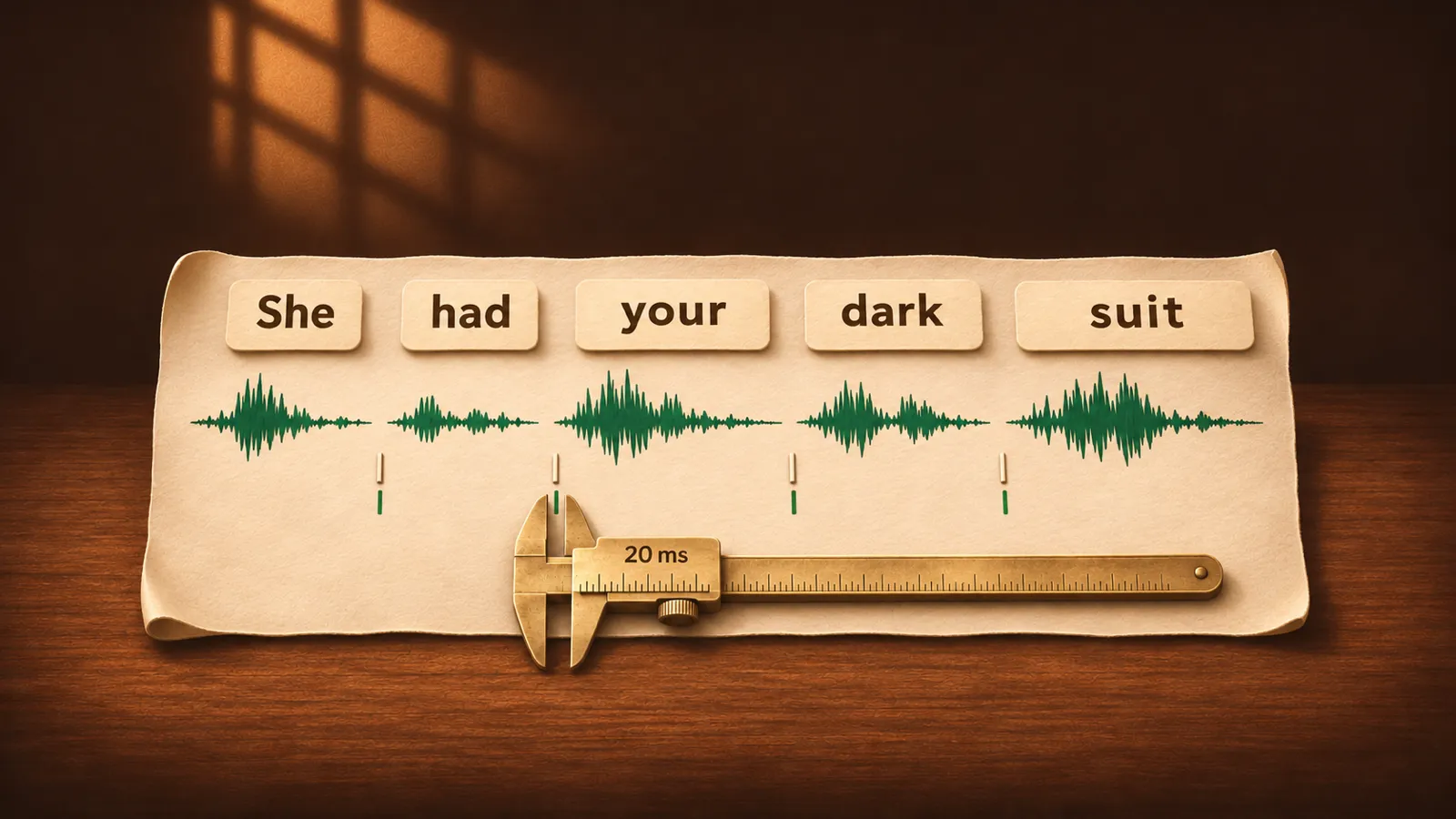
The 192 utterances of the TIMIT core test, clean read speech:
| MFA 3.4.1 | 21.8 ms |
|---|---|
| EdgeSpeak | 23.0 ms |
| ElevenLabs | 31.9 ms |
| Qwen3-ForcedAligner | 32.2 ms |
F1 as the tolerance widens:
| System | F1@20 | F1@40 | F1@50 |
|---|---|---|---|
| MFA 3.4.1 | 0.65 | 0.88 | 0.92 |
| EdgeSpeak | 0.62 | 0.86 | 0.90 |
| Qwen3-ForcedAligner | 0.40 | 0.73 | 0.82 |
| ElevenLabs | 0.17 | 0.38 | 0.47 |
Forced alignment on long audio: 10 to 60 minutes
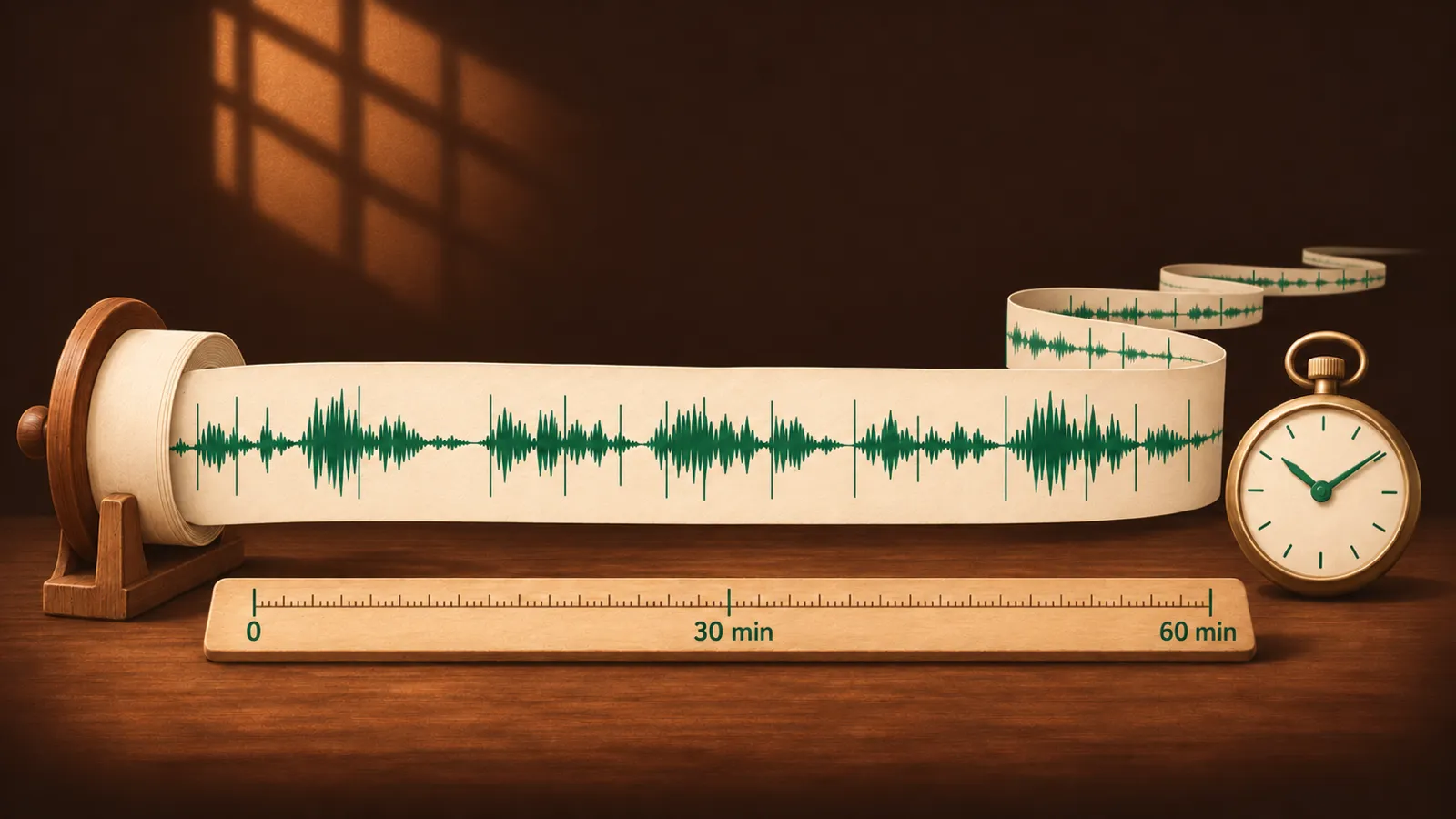
EdgeSpeak aligns 60 minutes in one pass with an error of 23.6 ms; aligned per utterance, the same set scores 23.4 ms. When the 60-minute recording is divided into 10 equal parts, the mean word-start error in each part stays between 18 and 22 ms, with no drift toward the end. Although 60 minutes is the longest test in this benchmark, EdgeSpeak supports recordings several hours long, so a whole meeting or an entire audiobook can be aligned in one pass.
The 9.7-minute test joins the 192 core-test utterances, while the 30- and 60-minute tests join training-set utterances end to end in a fixed order. The whole recording is sent at once, and the result is split back into utterances by word order before scoring.
| System | Length | Error | F1@20 | F1@40 | F1@50 |
|---|---|---|---|---|---|
| EdgeSpeak | 9.7 min | 23.3 ms | 0.62 | 0.86 | 0.90 |
| EdgeSpeak | 30 min | 23.7 ms | 0.62 | 0.84 | 0.89 |
| EdgeSpeak | 60 min | 23.6 ms | 0.62 | 0.85 | 0.89 |
| ElevenLabs | 9.7 min | 32.3 ms | 0.19 | 0.38 | 0.48 |
| ElevenLabs | 30 min | 31.7 ms | 0.20 | 0.40 | 0.48 |
| ElevenLabs | 60 min | 32.0 ms | 0.19 | 0.40 | 0.49 |
Qwen3-ForcedAligner supports up to 5 minutes of audio, so we added a 4.5-minute set: the first 90 core-test utterances for English and the first 55 Biaobei test sentences for Chinese.
| System | English, 4.5 min | Chinese, 4.5 min |
|---|---|---|
| EdgeSpeak | 22.8 ms / 0.62 | 14.3 ms / 0.79 |
| ElevenLabs | 34.0 ms / 0.19 | 54.9 ms / 0.15 |
| Qwen3-ForcedAligner | 44.2 ms / 0.41 | 44.3 ms / 0.36 |
Each cell is error / F1@20. Qwen3-ForcedAligner scores 32.2 ms in English and 34.2 ms in Chinese per utterance, rising to 44.2 and 44.3 ms when joined into 4.5 minutes.
We also tested a 26-minute English launch-event recording with 4 speakers and 374 hand-labelled sentences. After removing the 28 sentences where several people talk at once, EdgeSpeak's median sentence-start error is 30 ms, and 92.2% of sentences have both start and end errors within 0.2 seconds.
Chinese forced alignment: short utterances and 37-minute long audio
We take the last 500 sentences of the Biaobei test set and score per character against the hand-checked initial and final boundaries. Each character runs from the start of its initial to the end of its final; characters without an initial start at the final. Removing 13 erhua sentences whose character and syllable counts do not match leaves 487.
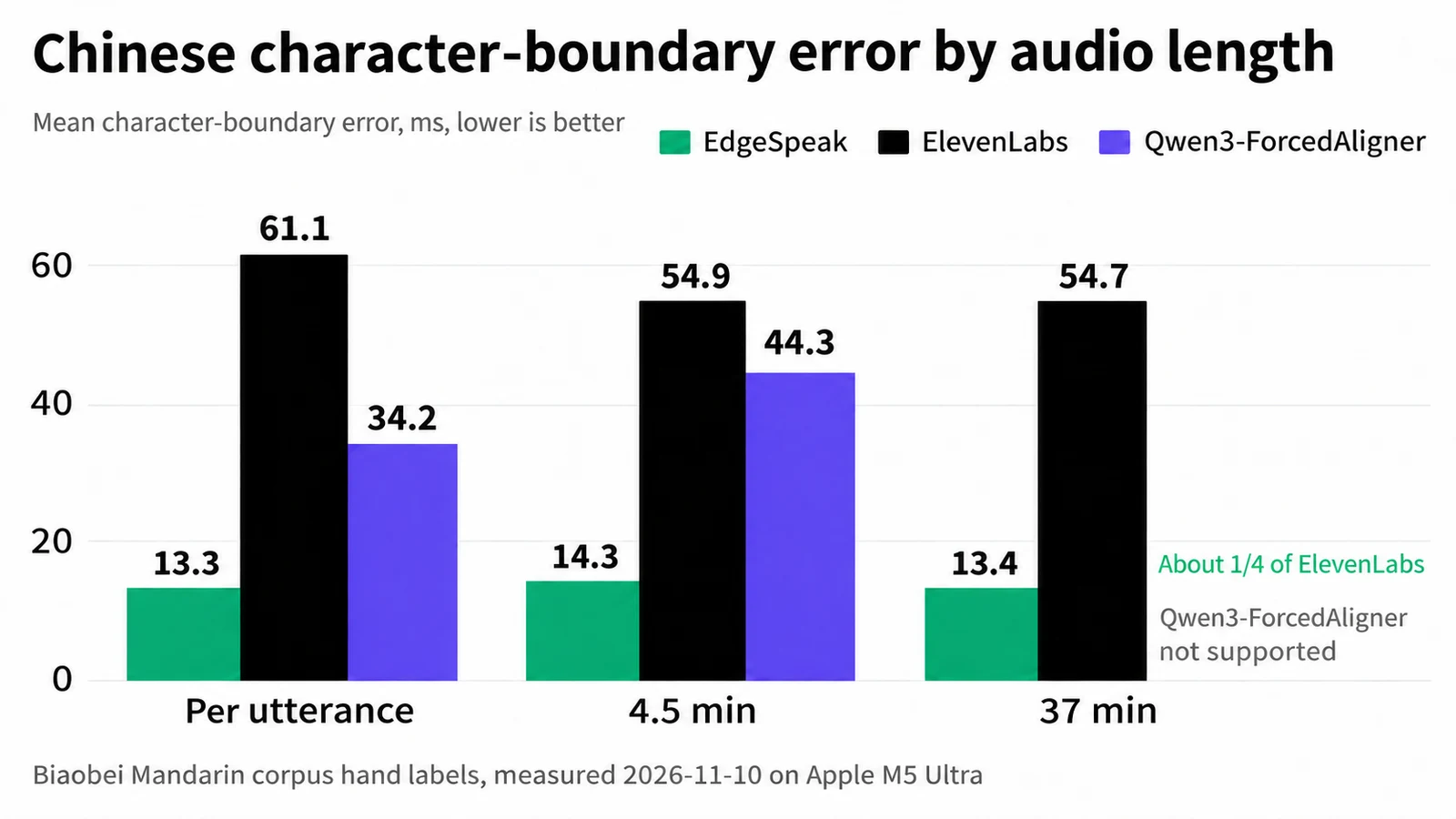
| System | Per utterance | Joined 37 min | 37-minute run time |
|---|---|---|---|
| EdgeSpeak | 13.3 ms / 0.80 | 13.4 ms / 0.80 | 10.2 s |
| ElevenLabs | 61.1 ms / 0.13 | 54.7 ms / 0.17 | 16.9 s |
| Qwen3-ForcedAligner | 34.2 ms / 0.34 | not supported | — |
Each cell is error / F1@20, per character. ElevenLabs scores slightly better on joined audio than per utterance.
English-Chinese switching: 60 minutes
English utterances (TIMIT) and Chinese utterances (Biaobei) alternate one by one, joined into 60 minutes, with no language specified. EdgeSpeak's Chinese error stays close to its per-utterance score (19.7 vs 18.9 ms), while English adds about 5 ms.
| System | Audio | English (per word) | Chinese (per character) |
|---|---|---|---|
| EdgeSpeak | per utterance (reference) | 23.6 ms / 0.60 | 18.9 ms / 0.72 |
| EdgeSpeak | joined 60 min | 28.2 ms / 0.60 | 19.7 ms / 0.72 |
| ElevenLabs | joined 60 min | 32.3 ms / 0.24 | 124.8 ms / 0.20 |
| Qwen3-ForcedAligner | joined 60 min | not supported (5-minute limit) | not supported |
Lyric alignment and karaoke subtitles
EdgeSpeak's alignment model also handles singing: align lyrics to vocals with accompaniment and export word-highlight karaoke subtitles. Lyrics with [Verse] and [Chorus] markers are expanded for repeated and skipped sections to match what is actually sung; see supported inputs.
Price and 60-minute run time
See pricing for EdgeSpeak. Run time is from submitting the 60-minute English recording to getting the result.
| System | Price | 60-minute run time |
|---|---|---|
| EdgeSpeak | $0.07–0.20 per hour depending on plan; Free covers about 53 minutes a month (see below) | 20.5 s |
| ElevenLabs | same as transcription, $0.22 per hour, silence billed | 163 s |
EdgeSpeak bills by input audio duration, counting 1 hour of audio as 45,000 tokens.
| Plan | Price | Audio included | Per hour |
|---|---|---|---|
| Free | 0 | about 53 minutes a month | — |
| Basic, monthly | $9 a month | about 44 hours a month | about $0.20 |
| Basic, yearly | $59 a year | about 533 hours a year | about $0.11 |
| Pro, monthly | $29 a month | about 222 hours a month | about $0.13 |
| Pro, yearly | $179 a year | about 2,666 hours a year | about $0.07 |
| EdgeSpeak Pro, yearly | 0.07 USD |
|---|---|
| EdgeSpeak Basic, monthly | 0.20 USD |
| ElevenLabs | 0.22 USD |
On-device processing and privacy
EdgeSpeak runs alignment on your device: audio, transcripts and results stay on your machine. See the privacy notice.
EdgeSpeak, MFA and Qwen3-ForcedAligner run locally; ElevenLabs needs the audio and transcript uploaded to the cloud.
Method and metric definitions
| System | Version and interface | Runs on |
|---|---|---|
| EdgeSpeak | edgespeak-cli, Python SDK align(), default alignment model Lattice-2 | local machine |
| MFA | 3.4.1, english_us_arpa v3.0.0 | local machine |
| ElevenLabs | Forced Alignment API | cloud |
| Qwen3-ForcedAligner | 0.6B, qwen-asr 0.0.6 | local machine |
Every system uses the same hand labels and the same scorer, one run per configuration. Scores are computed per utterance, then pooled over all boundaries; utterances with no output and words that do not match are included in the score.
- Error: the mean absolute difference, in milliseconds, between each hand-labelled word boundary and the system's; the end of one word and the start of the next count as a single boundary, and utterance starts and ends are included.
- F1@20: a boundary is a hit when it is within 20 ms of a hand-labelled boundary and the words on both sides match; F1 is the harmonic mean of precision and recall over boundaries, utterance edges included.
Long-audio results are first split back into utterances by word order, then passed to the same scorer. Feeding the hand labels in as output scores 0 ms and F1 1.0; short-utterance results sent through the split and scored again match direct scoring exactly.
TIMIT and Biaobei are clean read speech; singing is not scored.
Supported audio, video, transcripts and lyrics
| Input | Details |
|---|---|
| Audio or video file | Processed on the local machine, with support for recordings several hours long; the Python SDK also accepts audio bytes in memory and NumPy arrays |
| Transcript | Plain text, or a .txt, .json, .srt, .ass or .ssa file; existing subtitle timing is ignored and recomputed |
| Lyrics | Lyrics with section markers such as [Verse] and [Chorus] are first checked against the actual singing order and expanded for repeated, skipped and reordered sections before alignment; this can be turned off (see the CLI docs) |
| Language | The default alignment model covers 346 languages. Set one by code, such as zh, en-US or haw, or leave it unset to detect it from the transcript; pass und for mixed Chinese-English text |
Connect AI agents: MCP, Skills, CLI, SDK
When an agent calls EdgeSpeak, audio is processed on the local machine.
| Interface | For | How |
|---|---|---|
| MCP | Claude Code, Cursor and other MCP clients | claude mcp add edgespeak -- edgespeak-cli mcp, which provides 13 local tools including edgespeak_align |
| Skills | Claude Code, Codex, Cursor | npx skills add lattifai/EdgeSpeak, with skills for alignment, karaoke subtitles, transcription, segmentation, translation and speaker naming |
| CLI | Agents that run commands, scripts and batch jobs | edgespeak-cli align …, with JSON, SRT or plain-text output |
| Python SDK | Your own agents and data pipelines | pip install edgespeak, EdgeSpeak().align(...); this benchmark calls EdgeSpeak this way |
Once installed, tell the agent "use EdgeSpeak to align talk.mp4 with talk.txt and export SRT", or "make karaoke subtitles for this song".
Download and get started
Install the desktop app from the download page, import audio and a transcript on the Align page, then export SRT / VTT / ASS subtitles or karaoke subtitles.
The CLI is installed with the desktop app and can also be installed on its own; see the CLI docs.
Install the Python SDK with pip install edgespeak; usage is in the Python SDK docs.
The Python SDK's EdgeSpeak() starts an edgespeak-cli service on the local machine. Times in the result are in seconds, and errors raise EdgeSpeakError:
from edgespeak import EdgeSpeak

with EdgeSpeak() as client:
    # With a language
    a = client.align("speech.wav", text="His captain was thin and haggard and his beautiful boots were worn and shabby.", language="en")

    # Without a language: detected from the transcript
    b = client.align("lecture.mp4", text="今天我们讲强制对齐。")

    # A subtitle file as the transcript; its timing is recomputed
    c = client.align("episode.m4a", text_file="episode.srt")

for segment in a["segments"]:
    for w in segment["words"]:
        print(w["start"], w["end"], w["word"])
The result (times in seconds; score is a confidence score; source_start_byte and source_end_byte are the word's byte offsets in the transcript):
{
  "task": "align",
  "duration": 4.9728125,
  "language": "en",
  "language_candidates": ["en"],
  "text": "His captain was thin and haggard and his beautiful boots were worn and shabby.",
  "segments": [
    {
      "id": 0,
      "start": 0.33,
      "end": 4.973,
      "text": "His captain was thin and haggard and his beautiful boots were worn and shabby.",
      "words": [
        { "word": "His", "start": 0.53, "end": 0.77, "score": 1.0, "source_start_byte": 0, "source_end_byte": 3 },
        { "word": "captain", "start": 0.77, "end": 1.27, "score": 1.0, "source_start_byte": 4, "source_end_byte": 11 },
        { "word": "was", "start": 1.27, "end": 1.49, "score": 1.0, "source_start_byte": 12, "source_end_byte": 15 },
        { "word": "thin", "start": 1.49, "end": 1.75, "score": 0.9742, "source_start_byte": 16, "source_end_byte": 20 },
        { "word": "and", "start": 1.75, "end": 1.85, "score": 0.7779, "source_start_byte": 21, "source_end_byte": 24 },
        { "word": "haggard", "start": 1.85, "end": 2.39, "score": 1.0, "source_start_byte": 25, "source_end_byte": 32 },
        { "word": "and", "start": 2.39, "end": 2.51, "score": 0.6644, "source_start_byte": 33, "source_end_byte": 36 },
        { "word": "his", "start": 2.51, "end": 2.73, "score": 0.9867, "source_start_byte": 37, "source_end_byte": 40 },
        { "word": "beautiful", "start": 2.73, "end": 3.19, "score": 0.9679, "source_start_byte": 41, "source_end_byte": 50 },
        { "word": "boots", "start": 3.19, "end": 3.65, "score": 0.9939, "source_start_byte": 51, "source_end_byte": 56 },
        { "word": "were", "start": 3.65, "end": 3.79, "score": 1.0, "source_start_byte": 57, "source_end_byte": 61 },
        { "word": "worn", "start": 3.79, "end": 4.19, "score": 1.0, "source_start_byte": 62, "source_end_byte": 66 },
        { "word": "and", "start": 4.19, "end": 4.33, "score": 0.67, "source_start_byte": 67, "source_end_byte": 70 },
        { "word": "shabby.", "start": 4.33, "end": 4.87, "score": 0.8857, "source_start_byte": 71, "source_end_byte": 78 }
      ]
    }
  ],
  "search_effort_used": "standard",
  "usage": { "type": "duration", "seconds": 4.9728125 }
}
The CLI works the same way; --language is optional:
edgespeak-cli align speech.wav --text-file speech.txt --language en -o speech.srt
edgespeak-cli align lecture.mp4 --text-file lecture.txt -o lecture.json
More in the docs: CLI, Python SDK, Align API.